[ad_1]
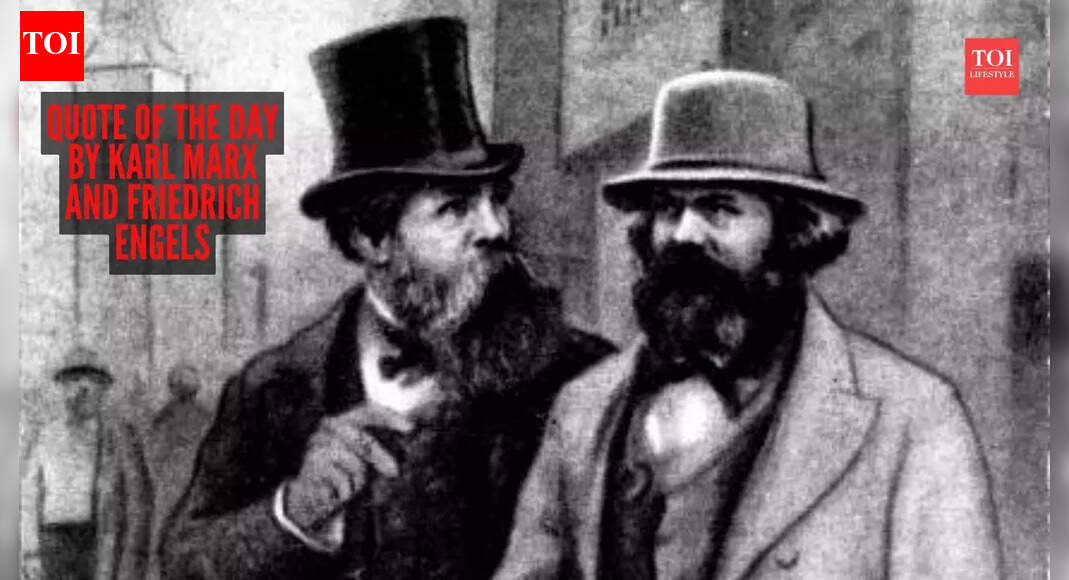
Karl Marx and Friedrich Engels stand among the most influential thinkers in modern history. Their collaborative works laid the foundation for Marxist philosophy, reshaping global conversations on economics, capitalism, and social structures. Marx, a German philosopher and economist, and Engels, a political theorist and industrialist, worked together to analyse how economic systems shape human life. Their most famous work, The Communist Manifesto, continues to inspire debates on class struggle, labour rights, and the human cost of capitalism. Together, they examined not just political structures, but the psychological and social impact of an economic system that rewards accumulation over human fulfillment.This profound quote, — “The less you eat, drink and read books; the less you go to the theatre, the dance hall, the public house; the less you think, love, theorise, sing, paint, fence, etc., the more you save-the greater becomes your treasure which neither moths nor dust will devour-your capital. The less you are, the more you have; the less you express your own life, the greater is your alienated life-the greater is the store of your estranged being,”– is widely attributed to Karl Marx and Friedrich Engels and appears in their discussions on alienation and the effects of capitalism on human life. It reflects a theme that runs throughout Marxist writings; that when individuals are encouraged to seek wealth as the highest achievement, they gradually disconnect from the deeper, more meaningful parts of life. Whether through academic study, recreation, artistic pursuits, or social relationships, Marx and Engels believed that true human development lies in experiences – not in the hoarding of material wealth.
Meaning of the quote
The quote captures a powerful critique of a society driven by accumulation. Marx and Engels argue that the more a person restricts their enjoyment, curiosity, creativity, and passion in order to save money or build capital, the more they lose themselves as human beings. When life becomes reduced to the pursuit of wealth, people gradually sacrifice the very experiences that give life richness and meaning – reading, thinking, loving, creating, socialising, and expressing oneself.In this societal framework, an individual’s worth is not gauged by their internal experiences or sentiments, but rather by the tangible assets they possess. As famously articulated by Marx and Engels, “the less you are, the more you have.” By stifling your own aspirations, happiness, and natural talents, you may find yourself accumulating greater wealth; however, this often results in an increasing disconnection from your authentic self. This quotation vividly illustrates how capitalism can lead to a profound estrangement of individuals from their essential humanity, transforming life into a mere financial equation and creating a rift between people and the inherent value of spontaneous, creative, and emotionally fulfilling living. Ultimately, the underlying message serves as a cautionary tale that warns about the dangers of pursuing wealth at the expense of one’s genuine self. It leads to a sense of inner desolation – a collection of “estranged being” that expands as individuals invest less in their personal development and more in the accumulation of material wealth.In the whirlwind of today’s fast-paced society, where the overwhelming focus often revolves around earning a living, saving for the future, and establishing a firm financial foundation, the profoundly insightful words of Marx and Engels continue to resonate remarkably in our contemporary world. Their thought-provoking quote strikes a deep chord within us and indeed prompts us to reflect on themes that are strikingly similar. It implies that genuine human happiness is not fundamentally derived from the accumulation of material wealth; instead, it is rooted in the more nuanced and profound aspects of life itself, such as spiritual fulfillment, enriching life experiences, and meaningful self-expression. This keen observation compels us to critically assess the prevailing systems that tend to prioritise profit over the well-being and happiness of individuals. Furthermore, it invites us to reclaim those essential elements of existence, which include art, intellectual inquiry, love, and joy – collectively encompassing the very essence of what it means to be human.In embracing this understanding, we are reminded to nurture the parts of life that enrich our spirit rather than diminish it. By choosing to live fully, expressively, and authentically, we reclaim the humanity that material pursuit alone can never provide.
[ad_2]
Source link